Operation Varsity: Photos taken by Robert Capa on the Battlefield near Hamminkeln Compiled and annotated by Alexander Berkel and Ortwin Nißing This series of photos presents all available images taken by the renowned photographer Robert Capa on March 24th, 1945. We attempted to arrange the photographs that he took before takeoff in France and after landing near Hamminkeln into a meaningful and coherent sequence.
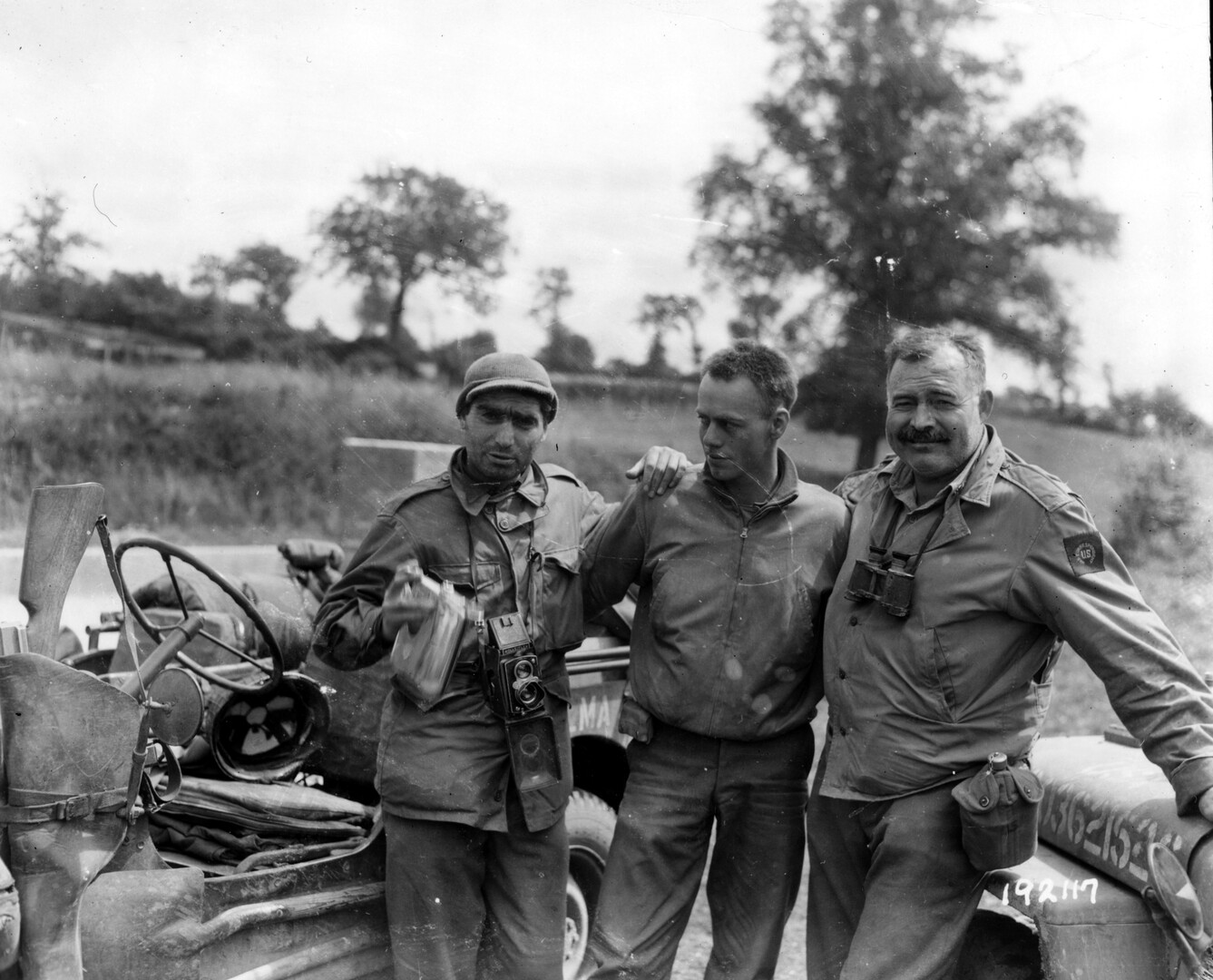
Robert Capa (left), with a US soldier and Ernest Hemingway – Capa and Hemingway were well-known
Robert Capa (1913–1954), born as Erno Endre Friedmann, was a journalist and photographer of Hungarian-Jewish origin. In the early 1930s, he studied journalism in Berlin, taking photographs primarily to earn a living. After the Nazis seized power, he settled in Paris.
Before World War II, he became to fame for his photographic coverage of the Spanish Civil War and the Sino-Japanese War. This is why he was primarily perceived as a war correspondent. In 1939, he emigrated to the USA. During World War II, he reported from many fronts and landed with Allied troops on “Omaha Beach” in Normandy on June 6th, 1944.
His mission on March 24th, 1945, was similarly daring and saw him parachuting into battle near Hamminkeln alongside the troopers of American 513th Parachute Infantry Regiment. On that day, he took numerous photographs in the Hamminkeln area, documenting what he witnessed during "Operation Varsity." Many of these pictures were taken in the Bislicher Wald and Mühlenrott area located between the Wesel-Emmerich railway line and the western village outskirts edge of Hamminkeln. Later that day, he also photographed in the Heiderott area, which was located to the south and had been used as landing zone “N” for US glider-borne units. Robert Capa spent the night in the combat zone on the eastern bank of the Rhine and returned to the western bank on March 25th to make his way to Paris.
A photo series covering the airborne operation at Hamminkeln was published in the US magazine "Life" on April 9th, 1945.
After World War II, Robert Capa became one of the co-founders of the Magnum photo agency. He was killed in 1954 while accompanying French troops on a combat mission during the Indochina War - he stepped on a mine and was fatally injured in the explosion.
In calm and more predictable situations Robert Capa photographed with a Rolleiflex camera.
Before going into action for Operation Varsity many paratroopers cut their hair “Mohawk-style”, taking inspiration from the famed fighting spirit of this Iroquois tribe.
Paratroopers' mission briefing on the day before Operation Varsity.
At a transit camp in France – the day before the battle.
Private James Conboy Jr. shortly before takeoff on March 24th, 1945 – a few hours later he was hit in the leg. He will later lose his limb by amputation.
Soldiers of 513th Parachute Infantry Regiment in a C-46 transport plane.
On the flight to the Rhine.
The X approximately marks the spot where Robert Capa landed on March 24th, 1945. The areas where he took photographs are circled.
In combat situations, Capa used a Zeiss Contax II camera - he carried two of these on this mission, complemented by the larger Rolleiflex.
Capa captures the moment of landing near Hamminkeln.
The first moments on German soil – Capa landed near a farm road named “Am Wall”, just west of Hamminkeln.
Soldiers whose parachutes became entangled in trees are almost defenseless and at great risk from German fire.
A group of officers trying to find their bearings in the area near “Am Wall”.
A dead US trooper near “Bislicher Strasse”, the camera’s perspective is pointing in the direction of Hamminkeln.
German prisoners near the Klump farm in the “Bislicher Strasse” area.
German prisoners and US paratroopers.
A dead paratrooper – Köpenhof farm can be made out in the background.
On “Bislicher Strasse”, in the area between the farm road “Am Wall” and Köpenhof farm.
A US soldier taking cover in the “Leitgraben”, a drainage ditch.
The drainage ditch is located east of Köpenhof farm.
From about 10:30 AM British gliders are descending on landing zone 'P' – just minutes after over 2,000 US paratroopers of 513th Parachute Infantry Regiment had been dropped there.
A British Horsa glider coming to a halt on landing zone 'P' between Hamminkeln and the “Diersfordter Wald” forest.
US paratroopers in the “Bislicher Strasse” area, looking towards Köpenhof farm.
The paratroopers are assembling and getting organized – by now they have realized that they were accidentally dropped on landing zone 'P', designated for British gliders.
In the initial phase after landing, the paratroopers come under fire from many directions.
The paratrooper units form combat groups to engage pockets of German resistance.
Photographer Robert Capa captures the actions of the paratroopers.
Paratroopers approaching a farm on landing zone “P”.
In the orchard of the Klump farm.
US soldiers at the Klump farm.
At the Klump farm – it is one of three farms located close together west of “Am Wall” farm road.
Civilians on March 24th, 1945 – anxiety and tension is showing on their faces.
The residents of the Klump farm are under guard.
Following the US troopers, Robert Capa approaches the burning Stegemannshof farm.
It is now about noon time – US gliders are about to land near the Stegemannshof farm.
Residents fleeing the burning farm.
A fallen paratrooper – in the background the Breihahn farm can be made out, located east of the turning from “Am Wall” onto “Bislicher Strasse”.
A lone German surrenders – a British airborne soldier is watching out. In the foreground an American paratrooper lies dead on the ploughed field.
First aid for a US paratrooper.
A US soldier named Jim Hayden claims to have recognized himself in these pictures. Hayden served in the 17th Airborne Division and was seriously wounded on March 24th, 1945.
A British soldier escorting a prisoner from a barn at the Stegemannshof farm – a wounded German NCO is visible in the lower right.
Searching the prisoners at the Stegemannshof farm.
A German half-track at Stegemannshof.
This picture was taken in the early afternoon.
These soldiers appear to be posing for Robert Capa's camera.
The camouflage pattern of the American parachutes is clearly visible in this picture by Capa.
In the early afternoon, an American trooper takes a wounded comrade to the first-aid station located at Klump Farm.
Hugging the ground is the preferred position for most troopers in this situation.
The medics can't stay in cover while they're doing their work: Improvised transport of a casualty to the Klump farm.
Three Americans are on their way to the aid post at the Klump farm along the “Westfeldweg” farm lane.
Looking for help – these two are also on their way to the Klump farm.
US medics have requisitioned a cart to collect wounded from the battlefield.
The same cart is waiting at the Klump farm for its next mission.
A view of the aid post at the Klump farm.
Captured German soldiers and civilians lie in the garden of the Klump farm; US paratroopers are advancing in the background.
Another photo taken at the same location; a heavy British Hamilcar glider is seen in the background.
Capa captured a close-up of the civilians being held captive alongside the German prisoners.
This picture was probably also taken in the area of the Klump farm.
Capa took this photograph on the farm lane next to the Klump, Schawach, and Wessels farms.
The same lane, this time looking south. Paratroopers are making their way to the Heiderott area passing a wrecked British Horsa glider.
This photograph was also taken on the lane now called “Zum Bislicherwald”.
Capa follows the US paratroopers heading towards the Heiderott area. Near the farm lane called “Westfeldweg” he photographs these remains of a Horsa glider, the casualty is a British airborne soldier.
In the Heiderott area, the paratroopers are crossing landing zone “N,” which had been designated for American Waco gliders. The high-voltage power line lies east of the road named “Kastanienstrasse”.
Courage or imprudence? An American paratrooper daring to expose himself – the tree line along “Kastanienstrasse” can be made out in the background.
On landing zone “N” in the Heiderott area – an anti-tank gun hooked up to a jeep. Both were carried into battle by Waco gliders.
Somewhere on landing zone “N” – a seriously injured American glider pilot receiving first aid.
The lone medic can do little to help this casualty.
A scene on landing zone “N”, east of “Kastanienstrasse” – photographed on the afternoon of March 24, 1945. The view is towards a farm lane called “Fasanenweg”.
The US paras are guarding German prisoners at Bleckmannshof farm.
224th Airborne Medical Company has set up a main dressing station in the Heiderott area, just south of Bleckmannshof farm.
On the orders of the Americans the residents of the surrounding farms must proceed to the Ortmannsfeld area.
The civilians collected in the Ortmannsfeld area waiting for further instructions from the Americans.
Among the civilians are Hermine Leimkühler and her children. This photo appeared in 'Life' magazine on April 9th, 1945.
Capa took several photos of the situation.
The children Erwin and Hilde with their mother, Hermine Leimkühler.
March 24th, 1945, was a Saturday – and the day when war came frighteningly close for the population of Hamminkeln.
The greatest danger seems to be over – but the horrors of the preceding hours are not forgotten.
Robert Capa describes his experiences during Operation Varsity – this column appeared in 'Time' magazine on April 2nd, 1945.
Vietnam 1954 – this is the last photograph Robert Capa took in his life. Minutes later, he stepped on a landmine and was killed.
Robert Capa is buried in Yorktown Heights, Westchester County, approximately 70 kilometers north of New York City.